Filters & Coatings
Bandpass Filters: Narrow and Broad Band, UV to IR
Glass bandpass filters that transmit a selected passband and block unwanted light, narrow or broad, UV to IR. Request a quote from Wavelength Optics USA.
Peak transmission
CWL tolerance
CWL shift with temperature
Spectral regions covered
Full catalogue
0 matching parts
| Part Number▲ | Product Name▲ | Dia (mm)▲ | Center λ (nm)▲ | FWHM (nm)▲ | Blocking λ (nm)▲ | T (%)▲ |
|---|
No parts match these filters. .
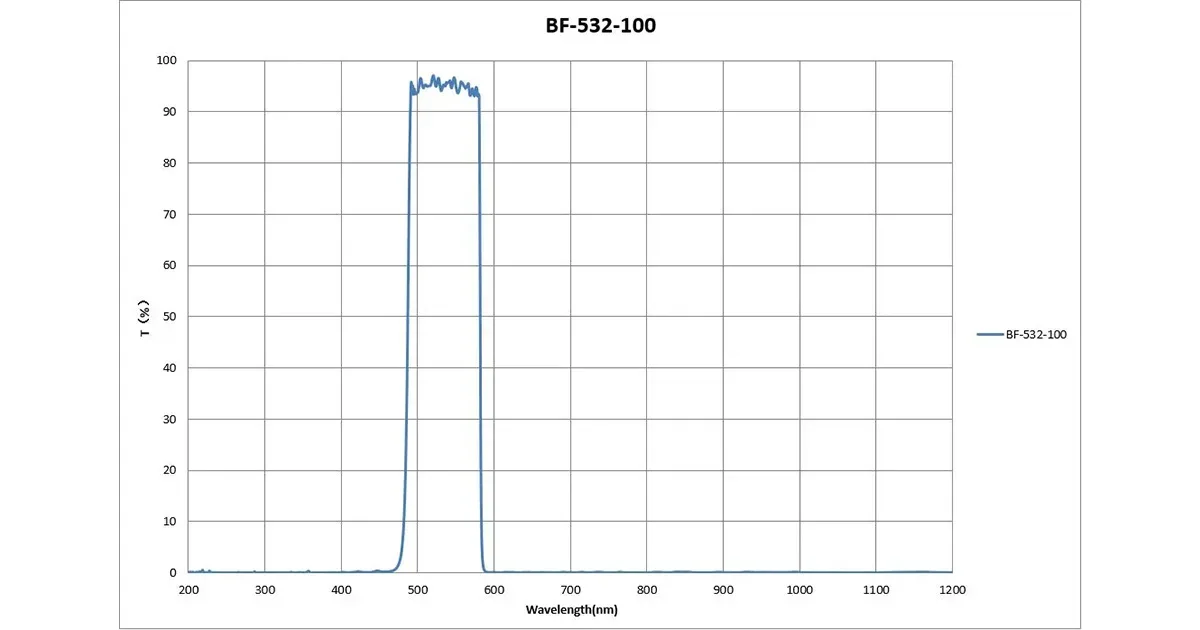
A bandpass filter transmits a defined range of wavelengths, the passband, and blocks light outside it. Wavelength’s glass bandpass filters come in narrow and broad bandwidths across the UV, visible, NIR and IR regions. You can use them to isolate an emission line, suppress ambient light in a vision system, or pick out the spectral band where your sample shows the most contrast. Surface coatings can be added to raise transmission through the passband. The filters are angle-sensitive, so how you place them in the optical path matters as much as the part you choose.
Where bandpass filters are used
Whether you’re building a fluorescence microscope, a spectrometer or an inline inspection station, the job is the same. Pass the signal you care about and reject everything else.
- Fluorescence microscopy and life sciences. Bandpass filters separate the emission signal from scattered excitation light, so faint fluorescence can be imaged against a dark background.
- Spectroscopy. A defined passband limits the light reaching the detector to the band under study. This improves signal-to-noise in analytical and process instruments.
- Food inspection. In sorting and grading lines, filtering to a specific band can make contaminants, bruising or foreign material stand out from good product.
- Silicon wafer inspection. Semiconductor tools use band-limited illumination and imaging to reveal defects and features that broadband light washes out.
- SWIR imaging. Filtering within the shortwave infrared gives high-contrast differentiation between materials that look identical in the visible.
- Legal and historic document analysis. Imaging in selected bands can reveal alterations, faded inks and underlying text for forensic examiners and conservators.
The filters pair naturally with machine vision lenses, line scan and telecentric optics, SWIR, MWIR and LWIR lenses, polarizers and machine vision lighting. This lets you specify the imaging chain together rather than part by part.
Selection and integration notes
A few points are worth settling before you commit to a part number.
- Centre wavelength and bandwidth. Narrow passbands give stronger rejection of nearby wavelengths, which suits line isolation and fluorescence. Broad passbands collect more light, which suits general imaging in a spectral region. Match the passband to your source’s emission and your detector’s response.
- Blocking range. Look at how far out-of-band rejection extends on either side of the passband. Light leaking in an unblocked region can still reach a silicon or InGaAs sensor.
- Angle of incidence. Bandpass filters are angle-sensitive, and the passband shifts as light arrives off-normal. In converging or diverging beams, or in wide-field imaging, filter position and orientation need careful thought. Placing the filter where rays are closest to collimated generally preserves performance.
- Temperature. Centre wavelength drift with temperature is low. Still, account for it if your system runs in an uncontrolled environment or alongside heat-generating sources.
- Coatings. Surface coatings can increase transmission. This is useful when your signal is weak or the filter is one of several surfaces in the path.
The structured spec table on this page lists diameter, centre wavelength, FWHM, blocking range and transmission for each catalogue part. Use it to narrow the field, then confirm the fit against your optical layout.
Why buy through Wavelength Optics USA
Wavelength Optics is the US arm of Wavelength Opto-Electronic, the Singapore manufacturer of these filters. Buying through the US entity gives you a local point of contact in your time zone for quoting, order questions and follow-up.
If a catalogue part doesn’t quite match your passband, blocking requirement or mechanical envelope, custom configurations are available. Send us your source wavelength, detector, beam geometry and any space constraints, and we’ll help you work through filter selection and placement before you quote. That’s especially worthwhile for angle-sensitive designs, where an early conversation about where the filter sits in the system can save a redesign later.
Request a quotation through the form on this page, or contact the Wavelength Optics USA team to discuss your application.
Need Help Choosing the Right Model?
Our photonics specialists can help you select the optimal configuration for your system. Custom specifications available on request.