Laser Optics · CO2 Series
CO2 Laser Optics for 9.4 and 10.6 µm Systems
CO2 laser optics for 9.4/10.6 µm systems: standard and telecentric F-theta lenses, beam expanders, ZnSe lenses and mirrors. Quote via Wavelength Optics USA.
CO2 laser wavelengths supported
Typical F-theta distortion
UniBET beam expander power class
Lens materials
Full catalogue
0 matching parts
| Part Number▲ | Wavelength (nm)▲ | EFL (mm)▲ | Scan Field (mm x mm)▲ | Input Beam Dia (1/e2) (mm)▲ | F-Theta (Standard or Telecentric)▲ | Material▲ | Mounting Thread▲ | WD (mm)▲ | Magnification▲ | Type▲ | Input CA (mm)▲ | Output CA (mm)▲ | Max. Outer Dia (mm)▲ | Total Length (mm)▲ | Max. Input Beam Dia (1/e(2) (mm)▲ | Dia (mm)▲ | Product Type▲ | Cone Angle (deg)▲ | ET (mm)▲ | Assembly▲ | Dimension (mm)▲ | CT (mm)▲ | Thickness (mm)▲ | AOI▲ | Reflectivity▲ | Radius▲ | Reflectivity (%)▲ | Product Name▲ | Dimension (mm x mm)▲ | Angle on Incidence (°)▲ | Diameter (mm)▲ | Application▲ |
|---|
No parts match these filters. .
In a CO2 laser system, the optics that transmit, shape and focus the beam set the limits on spot quality, field uniformity and process repeatability. Wavelength Opto-Electronic designs and manufactures a full range of 9.4/10.6 µm optics: F-theta scan lenses, beam expanders, aspheric, axicon, cylindrical and spherical lenses, beam combiners and splitters, cavity optics, mirrors, thin film polarizers and optical windows. Whether you’re building a galvo-based marking head, upgrading a cutting system, or specifying a replacement lens for an existing engraver, you can source the beam path from one manufacturer.
F-Theta Scan Lenses for Galvo Systems
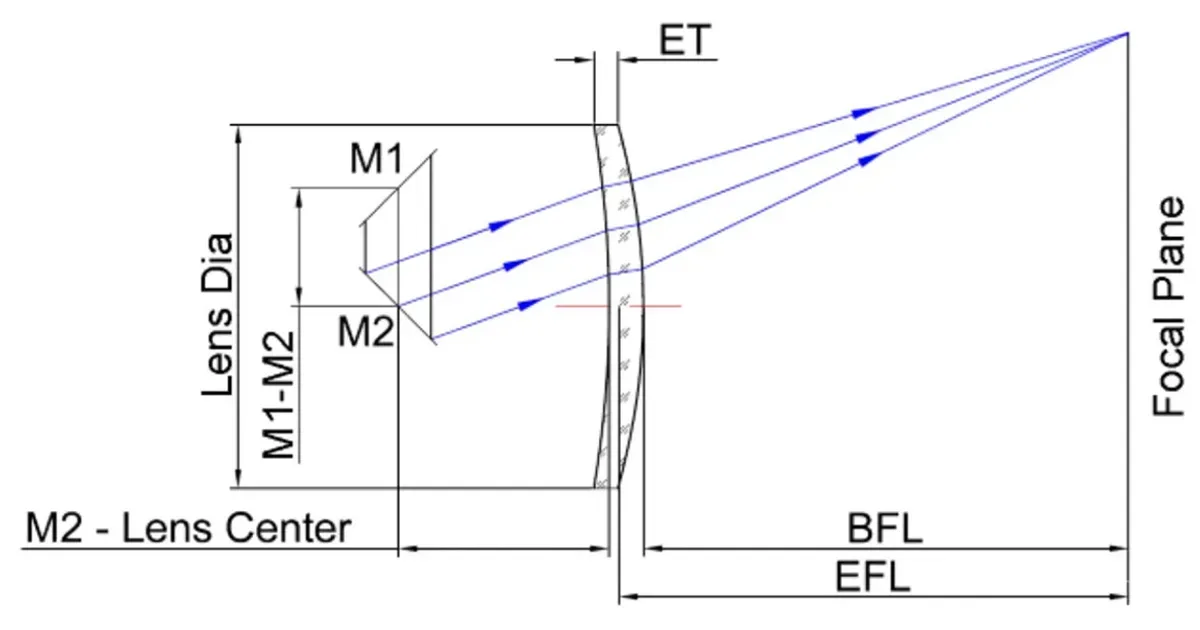
F-theta lenses are paired with galvanometer scanning mirrors in laser engraving, cutting and marking systems. F-theta distortion is typically kept under 1%, so the lens produces a precise spot across a flat field at the image plane. The range comes in four configurations, so you can match lens complexity to the precision your process needs:
- SL1 (singlet). The baseline option for general galvo engraving, cutting and marking.
- SL2 (doublet). Gives a more even spot size and less spot distortion across the scan field than a singlet. It is available in ZnSe or GaAs.
- SL3 (triplet). Uses three ZnSe elements, with or without a protective window. It reduces spot distortion further and gives a more even spot size than SL1 or SL2. It is used for finer CO2 work such as electronic microprocessor applications.
- TSL (telecentric). Keeps the focused beam perpendicular to the flat field across the scan. The system stop sits at the front focal point of the lens. In a single-axis scanner, that point is at the scanning mirror. In a two-axis system, it is midway between the mirrors. Use a telecentric design when the angle of incidence at the workpiece matters, for example in drilling or in processes where edge geometry has to stay consistent across the field.
Lens adaptors for major scan head providers are available on request, so a scan lens can fit an existing galvo head without a custom mount.
Beam Expanders
Expanding the beam before the scan lens lets you control the focused spot size and the beam divergence. The CO2 beam expander range includes:
- Fixed beam expanders. Galilean designs for a set magnification.
- UniBET beam expanders. Built for high-power CO2 sources above 100W.
- Motorized zoom beam expanders. Magnification adjusts in approximately 5 seconds per step. This suits systems that change spot size between jobs or within a process recipe.
Lenses, Mirrors and Beam-Path Components
Beyond the scan head, the catalogue covers the rest of a CO2 optical train:
- Focusing and shaping lenses.
- Aspheric lenses for low-aberration focusing.
- Axicon lenses for ring and line-focus profiles.
- Cylindrical lenses for one-axis shaping.
- Spherical lenses for general focusing and collimation.
- Beam management.
- Beam combiners for merging a visible guide beam with the CO2 beam.
- Beam splitters.
- Thin film polarizers.
- Resonator and delivery.
- Cavity optics.
- Optical mirrors for beam steering.
- Windows for sealing and protecting the beam path.
Transmissive parts are made in Zn
Need Help Choosing the Right Model?
Our photonics specialists can help you select the optimal configuration for your system. Custom specifications available on request.