Laser Optics · Diffractive Optics
Diffractive Optical Elements (DOE): Beam Shapers & Beam Splitters
Diffractive optical elements in fused silica: top hat beam shapers and multi-spot beam splitters for laser processing. Get a quote from Wavelength Optics USA.
Substrate material for both DOE variants
AR/AR coating options for beam splitters
Beam splitter separation angle
Top hat beam shaper output shapes
Full catalogue
0 matching parts
| Part Number▲ | Wavelength(nm)▲ | Input BeamDia (mm)▲ | F-Theta FL (mm)▲ | DOE Size (mm)▲ | Beam Shape▲ | Flat Top Beam Size (μm)▲ | Wavelength (nm)▲ | Dia (mm)▲ | Thickness (mm)▲ | Separation Angle▲ | No. of Spots▲ |
|---|
No parts match these filters. .
Diffractive optical elements (DOEs) use a surface microstructure etched into a fused silica window to control the phase and amplitude of a laser beam, shaping collimated light into a defined output pattern. Wavelength Optics offers two DOE variants: Top Hat Beam Shapers, which convert a Gaussian beam into a uniform-intensity spot, and Diffractive Beam Splitters, which divide one input beam into multiple separated beams. Whether you’re tightening edge quality on a scribing line or adding parallel processing to a marking head, a DOE lets you change what the beam does at the work surface without rebuilding the rest of the optical train.
Top Hat Beam Shapers
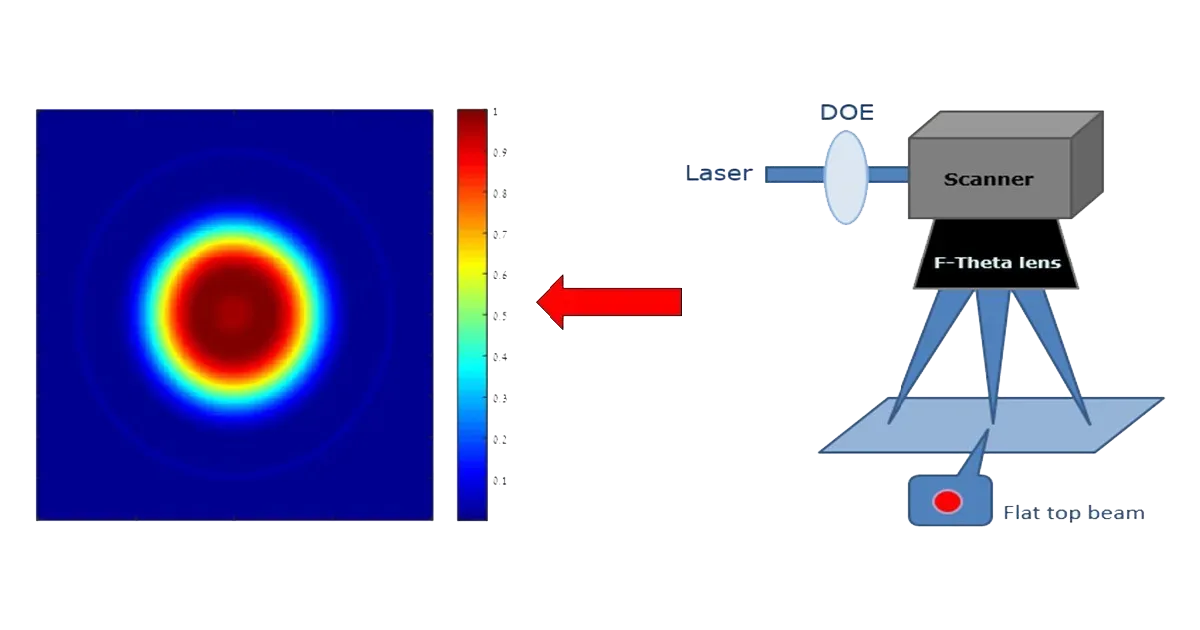
A Gaussian (TEM₀₀) beam concentrates energy at the center of the spot and tapers off toward the edges. For many processes that profile is a liability: the center overheats while the edges under-process, leaving a wide heat-affected zone and soft feature boundaries. A Top Hat Beam Shaper redistributes that energy into a spot of uniform intensity with sharper edges.
The typical setup is a laser source, the beam shaper DOE, a scan system or focusing lens, and the working surface. The shaper is designed for single-mode or TEM₀₀ input with M²<1.5, so beam quality from your source matters during selection. Transmission efficiency is ~100%, with overall efficiency of 90-95%. Output spots are available in circular and rectangular shapes, and standard parts carry AR/AR coatings at 532nm and 1064nm. Each shaper is matched to a specific input beam diameter and focal length of the downstream F-Theta lens, so the flat-top spot size is set by the system, not just the DOE.
Diffractive Beam Splitters
A Diffractive Beam Splitter takes a collimated input and divides it into a 1 x N or M x N array of output beams, each leaving the element at a defined separation angle. For an odd number of beams, a zero-order beam is part of the designed pattern. A focusing lens after the DOE typically places the spots at the working distance you need.
Beam splitters accept single-mode or multimode input, use a separation angle of ≤ 5°, and offer transmission efficiency of ~100%. Spot-to-spot uniformity is held tightly, and unwanted zero-order energy is kept to a small fraction of the incident beam; the spec table lists exact figures per part. Standard AR/AR coatings are available at 355nm, 532nm and 1064nm, which covers the common UV, green and near-infrared solid-state and fiber laser lines.
Where DOEs Are Used
Beam shapers and splitters show up across laser material processing and beyond:
- Industrial laser processing: cutting, drilling, welding, engraving and laser cleaning, where uniform spots improve edge definition and multi-spot patterns raise throughput.
- Solar manufacturing: panel scribing and grooving, where consistent energy across the spot keeps line quality even.
- Semiconductor and display: laser lift-off, where a flat-top profile delivers even fluence across the processed area.
- Medical devices: laser treatment systems that need controlled, repeatable spot profiles on tissue.
- Scanning and metrology: structured multi-beam patterns for laser scanning and measurement.
If your requirement falls outside the catalogue (a different wavelength, spot geometry, beam count or array layout), custom configurations are available.
Why Buy Through Wavelength Optics USA
Selecting a DOE is a system-level decision: input beam diameter, beam mode, wavelength and the focal length of your scan lens all determine whether a given part delivers the spot you expect. Our US team works with you directly on that selection, reviewing your laser and optical layout before you commit to a part number or a custom design. You get quotes quickly, technical answers in your time zone, and local support through integration and reorders, backed by the design and manufacturing capability of Wavelength Opto-Electronic. Send us your laser specifications and target spot or pattern, and we’ll help you identify the right element.
Need Help Choosing the Right Model?
Our photonics specialists can help you select the optimal configuration for your system. Custom specifications available on request.