Imaging Lenses · Spherical Optics
Focusing Lenses: Plano-Convex, Plano-Concave, Meniscus and Ball
Focusing lenses in six forms, from plano-convex to ball lenses, in optical glass, fused silica, calcium fluoride and sapphire. Quote via Wavelength Optics USA.
Catalogue part numbers
Lens configurations
Material coverage
Designs on request
Full catalogue
0 matching parts
| Part Number▲ | Wavelength (nm)▲ | Diameter (mm)▲ | EFL (mm)▲ | Material▲ | Assembly▲ | CT (mm)▲ | ET (mm)▲ | BFL (mm)▲ | Product type▲ |
|---|
No parts match these filters. .
Focusing lenses refract light at curved surfaces to converge or diverge a transmitted beam. They are the basic building block of most optical trains. Whether you’re collimating a diode output, setting the working distance on a machine vision camera, or expanding a beam ahead of a scan head, the lens shape and material set how your system performs. Wavelength Optics supplies the Wavelength Opto-Electronic range of standard focusing lenses, with custom designs available when a catalogue part doesn’t fit your optical layout.
Lens configurations
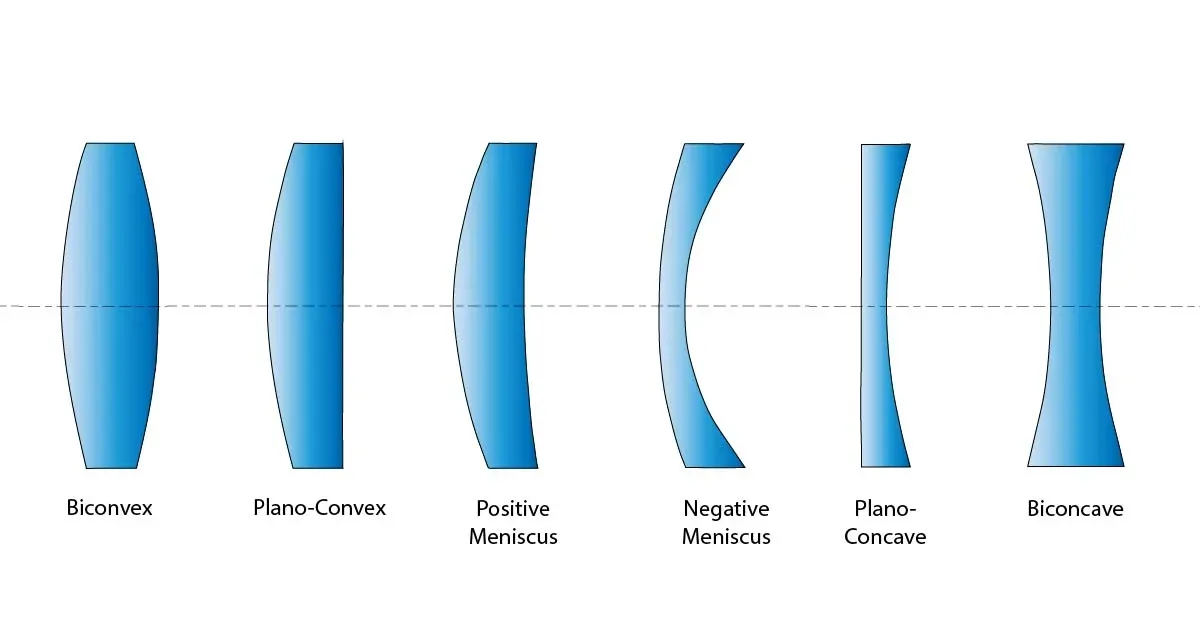
The range covers six spherical lens forms. You can select by function:
- Convex (positive) lenses are thicker at the center and taper toward the edge. Parallel rays converge to a real focal point. Use them for focusing and imaging.
- Concave (negative) lenses have a thinner center and thicker edges. Parallel rays diverge as if from a virtual focal point. Use them for beam expansion and for spreading incoming light.
- Plano-convex lenses pair one flat surface with one convex surface. They are a common choice for focusing collimated light, and for imaging systems, projectors and magnifiers.
- Plano-concave lenses pair one flat surface with one concave surface. They have a negative focal length and are used for light projection, beam expansion, or to increase the effective focal length of an optical system.
- Meniscus lenses have one convex and one concave surface. Designers typically use them alongside other elements in multi-lens assemblies.
- Ball lenses are full spheres. They are used for short focal length coupling tasks such as fiber coupling.
Focal length is the main selection parameter. A shorter focal length converges light more aggressively, and a longer one gives more gradual convergence. The catalogue lists effective focal length, back focal length, diameter, center and edge thickness, material and design wavelength for each part. You can filter the spec table below to narrow the options before you contact us.
Material selection
Material determines transmission range and how a lens behaves in your environment:
- Optical glass for visible-spectrum imaging and illumination.
- Fused silica for near-infrared and short-wave infrared work, including many laser applications.
- Calcium fluoride for near-infrared to short-wave infrared systems.
- Sapphire for near-infrared to short-wave infrared use where a hard, durable substrate is needed.
If your system spans more than one band, or you need to balance cost against performance, our engineers can help you weigh the trade-offs.
Applications
Focusing lenses from this range are specified across several industries:
- Laser processing: focusing and beam-shaping optics in cutting, welding, marking and fiber laser delivery systems, and plano-concave elements in beam expanders.
- Machine vision: singlet and assembly elements in inspection cameras and illumination optics.
- Semiconductor equipment: optics for alignment, metrology and inspection tools.
- Medical and life sciences: imaging optics, illumination paths and diagnostic instrumentation, with lens principles that also apply to visual correction.
- Projection and display: condenser and projection elements.
Why buy through Wavelength Optics USA
Wavelength Optics is the US arm of Wavelength Opto-Electronic, and it gives US engineering and purchasing teams a local point of contact for the full catalogue:
- Local support: work with a US team in your time zone, from first enquiry through delivery.
- Fast quoting: send part numbers or a target specification and receive a quote for standard or custom lenses.
- Selection help: discuss focal length, material and lens form with engineers who can recommend a catalogue part or scope a custom design for your system.
Browse the spec table to shortlist part numbers, or contact Wavelength Optics USA with your requirements to start a quote.
Need Help Choosing the Right Model?
Our photonics specialists can help you select the optimal configuration for your system. Custom specifications available on request.