Infrared Optics
IR Windows in ZnSe, ZnS, Ge, Si, CaF₂ and Sapphire
IR windows in ZnSe, ZnS, germanium, silicon, CaF₂ and sapphire for FTIR and thermal imaging. Get expert selection help and quotes from Wavelength Optics USA.
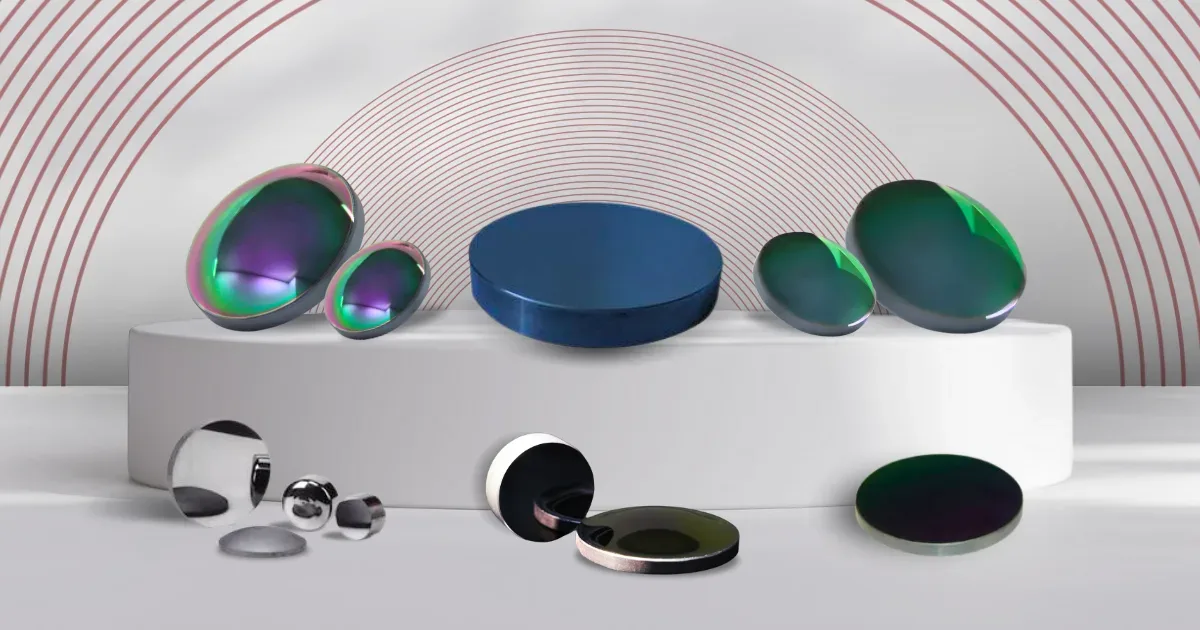
Catalogue parts across sizes and materials
ZnSe, ZnS, Ge, Si, CaF₂ and sapphire
ZnSe coating, per surface @10.6μm
ZnSe surface flatness per 1″Dia@632.8nm
Full catalogue
0 matching parts
| Part Number▲ | Wavelength (nm)▲ | Material▲ | Diameter (mm)▲ | Thickness (mm)▲ | Application▲ |
|---|
No parts match these filters. .
IR windows transmit infrared radiation while sealing off and protecting the optics behind them. They separate environments at different pressures or temperatures and still let energy at the wavelengths you care about pass between them. Whether you’re protecting a thermal camera in an enclosure, building a sample cell for an FTIR spectrometer, or putting an inspection port into a switchgear cabinet, the window has two jobs. It must keep its optical clarity, and it must add as little distortion as possible to the transmitted beam. Wavelength Opto-Electronic manufactures IR windows in six substrate materials and in a range of diameters and thicknesses. That lets you match the window to your spectral band and mechanical envelope rather than design around a stock part.
Choosing a material by transmission range
The most important decision is the substrate, because each material has its own transmission profile. Refractive index and hardness also affect which window suits a given system.
- Germanium (Ge) and Silicon (Si) are opaque to UV and visible light but transmit across the infrared region. They suit IR-only systems where blocking visible light is acceptable or useful.
- Zinc Selenide (ZnSe) and Zinc Sulphide (ZnS) transmit from the visible spectrum through to long-wavelength infrared. Choose them if you need a visible alignment beam or visual inspection through the same window used for LWIR work. ZnSe windows are offered with an anti-reflection coating, and Brewster-angle configurations are also available.
- Calcium Fluoride (CaF₂) and Sapphire (Al₂O₃) transmit from the UV through to mid-wavelength infrared. CaF₂ is non-birefringent and has a low refractive index, so it can be used without an AR coating in some designs. Its high coefficient of thermal expansion makes it a poor fit for high operating temperature environments.
If your band spans more than one of these regions, or you’re trading transmission against durability, the choice is not always obvious. We can help you with that selection (see below).
Where IR windows are used
FTIR spectroscopy. Windows act as the transmissive boundary for sample cells and instrument ports. The material must pass the full band of interest without introducing absorption features of its own.
FLIR and thermal imaging. In forward-looking infrared and other thermal cameras, the window protects the lens and detector from the operating environment while passing the imaging band.
Thermography and electrical inspection. IR windows are widely used in maintenance programs for electrical distribution equipment. Fitted to circuit breakers, switches, switchboards, switchgear and transformers, they let a technician use a thermal camera to find hot spots from electrical faults, malfunctions or thermal leaks. The equipment stays closed, which protects personnel working near live electrical equipment and protects the equipment itself.
Medical infrared systems. Medical instruments that sense or image in the infrared use windows to isolate the optical path while keeping the transmission the measurement depends on.
Why order through Wavelength Optics USA
Wavelength Optics is the US arm of Wavelength Opto-Electronic. You get direct access to the manufacturer’s catalogue and engineering team, with support in your time zone.
- Local technical support. Talk to someone who can discuss your application directly, without routing questions overseas and waiting a day for each reply.
- Fast quoting. Send us a part number from the catalogue or a description of what you need. We’ll come back with a quote that reflects your quantities and requirements.
- Selection consultation. If you’re unsure whether ZnSe or ZnS fits your LWIR system better, or whether sapphire or CaF₂ suits a UV-to-MWIR application with your thermal conditions, we can work through the trade-offs with you. That includes transmission band, coating, thickness for your pressure differential, and size for your housing.
Browse the full specification table below to filter by material, diameter, thickness and wavelength. If you don’t see an exact match, contact Wavelength Optics USA to discuss sizes and thicknesses for your system.
Need Help Choosing the Right Model?
Our photonics specialists can help you select the optimal configuration for your system. Custom specifications available on request.